





Labour is planning to cap the number of skilled foreign workers that companies can recruit from abroad, to reduce net migration.
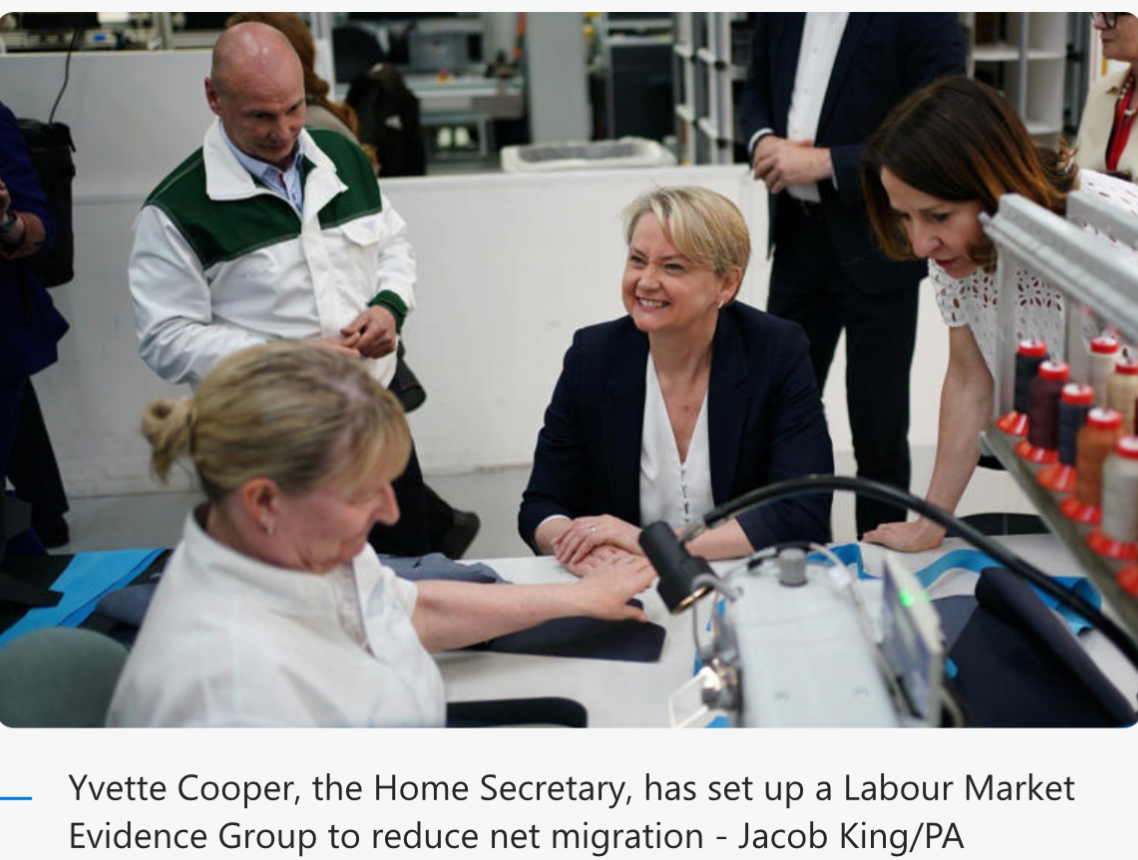
Yvette Cooper, the Home Secretary, has asked a panel of experts to consider the introduction of an annual or monthly cap on the number of skilled workers recruited from overseas for jobs where there is an official shortage.
Companies that fail to train UK workers to plug skills shortages will also be barred from recruiting overseas staff under the proposals, which aim to reduce net migration by at least 60,000 a year.
The plans were revealed by Prof Brian Bell, the head of the Migration Advisory Committee, in an interview with The Telegraph.
He is part of a new Labour Market Evidence Group (LMEG) set up by Ms Cooper to advise her on ending UK businesses’ reliance on cheaper foreign labour by forcing them to train British workers.
Prof Bell said: “There is potentially an argument that says not only should you have this new temporary shortage list, but actually you might want to say there’s an absolute cap on the numbers that can come on that route. That’s feasible.
“The Home Secretary is certainly interested in the idea of thinking about how we make sure that there’s a sort of emergency stop. There’s a risk that you put 50 occupations [on the temporary shortage list] and they suddenly go wild in recruitment, although I don’t think this will happen.”
An immigration cap would blunt similar policy proposals from the Tories and Reform. Nigel Farage has committed to a “net zero” immigration policy, while Kemi Badenoch has proposed an annual cap on the number of migrants, agreed each year by Parliament.
Central to Ms Cooper’s shake-up is a requirementthat migrant workers can only come to the UK for jobs that are graduate level or above. This raises the previous A-level threshold introduced by Boris Johnson.
Mr Johnson’s more liberal approach, including a target of attracting 600,000 overseas students a year, has been blamed for pushing net migration to a record 906,000 in the year ending June 2023. It has fallen to 431,000 after Rishi Sunak placed new curbs on work and student visas.
Ms Cooper’s raised threshold means 120 non-graduate occupations, including retail workers and chefs, face being automatically barred from recruiting workers from abroad by the end of next year
However, up to 60 other non-graduate occupations deemed crucial to Labour’s industrial strategy and maintaining Britain’s critical infrastructure will temporarily escape this ban, provided they come up with plans to train Britons for the jobs.
The 60 occupations are expected to include welders, electricians, plumbers, construction workers, car mechanics and boat and ship builders, as well as painters, decorators and data analysts.
Carrot and stick approach
Prof Bell said these job sectors would have to develop “sensible” and “deliverable” plans for training British workers in order to be allowed to bring in skilled foreign staff to plug shortages.
He warned that if they failed to deliver these training packages, they would lose their right to recruit foreign staff. “Where we’ll be really unsympathetic is if a sector has said ‘we’re going to train 10,000 bricklayers’, and they train 100, then we’re going to say ‘well, tough, you’re on your own now’,” he said.
“You’re not getting access to migrant workers because you’ve deliberately decided not to bother training British workers. That’s your choice but you’re going to live with the consequences.
“Companies are going to have to have clear plans in place that are deliverable and unless that happens, the immigration route will be closed down. It’s a carrot and stick. If you’re doing the right stuff and it’s just going to take time to train British staff, the immigration system can help you and it can smooth that transition.
“But there’s a stick there which says if you don’t do the work you need to do on skills and training, that it will get closed down.”
Prof Bell said the Government would also set salary thresholds in each of the shortage job sectors to prevent businesses undercutting market pay rates through cheaper foreign labour.
He said these could be set above market rates, adding: “We really want to make sure you’re incentivised to train domestically and if you’re saying that the problem is that you can’t get these workers and they’re crucial to what you’re doing well, you might pay a bit more for that.”
He also warned the 120 occupations locked out of bringing in foreign workers that they must “start recruiting domestically”, train up UK staff and consider automating more jobs.
“There’s no access to the immigration system for those 120. They have no chances of getting on the list. The Home Secretary is not going to backtrack,” he said.
Prof Bell said the LMEG would spend the next 12 months reviewing which occupations should be allowed to recruit skilled workers from abroad. This would be based on whether they were “crucial” to Labour’s industrial strategy, suffered genuine shortages and had viable training plans for British workers, he said.
He suggested some of those on a current “interim” list of 60 shortage occupations, such as HR professionals, could be whittled down further. Skilled workers who came in under the old points system will be allowed to renew their visas.
However, the Home Office has yet to announce whether they will be entitled to claim indefinite leave to remain after five or 10 years as part of its white paper crackdown on immigration.
Culled from: The Telegraph.










Leave a comment